
forScore
$24.99
- iPad
- iPhone
- Mac
Choose forScore if
Solo players, pianists and accompanists on iPad or Mac who want the most refined reader for a one-time price.
Two pay-once readers with deep page turning and library tools. forScore is the refined Apple choice, MobileSheets the one that runs almost everywhere. How they differ, criterion by criterion.
forScore
$24.99
Choose forScore if
Solo players, pianists and accompanists on iPad or Mac who want the most refined reader for a one-time price.

MobileSheets
$15.99
Choose MobileSheets if
Players on Android tablets or Windows 2-in-1s, and anyone with a very large library who wants one-time pricing.
forScore and MobileSheets are two of the most complete PDF sheet music readers you can buy outright, and both have been refined for well over a decade. The choice mostly comes down to your devices: forScore is built for Apple hardware only, while MobileSheets runs on Android, Windows, iPad and iPhone.
MobileSheets scores 7.9 in our overall ranking and forScore 7.5. MobileSheets’ lead comes mostly from platforms, plus smaller edges on chord charts, sharing and value. forScore scores higher on reading and annotation, the two criteria a solo iPad player notices most. Our methodology explains the weights.
Pick forScore if you play from an iPad, iPhone or Mac and want the most polished reader on Apple hardware. Pick MobileSheets if you read from Android or Windows, play in a band with mixed devices, or want chord charts and a lower price.
On an iPad alone, it’s close. forScore wins on page-turning polish and Apple integration: free AirPods head gestures, automatic iCloud sync, a native Mac app, and a tuner and recorder built in. MobileSheets costs $15.99 instead of $24.99, lets you try it free, includes face gestures without a subscription and reads ChordPro and ABC files that forScore can’t.
| Features | forScore | MobileSheets |
|---|---|---|
| Our score | ||
| Our score | 7.5 | 7.9Edge |
| Reading & page turning · 20% | 9.5Edge | 9.0 |
| Annotation · 15% | 9.5Edge | 9.0 |
| Library & setlists · 15% | 9.5 | 9.5 |
| Platforms & sync · 15% | 5.5 | 7.5Edge |
| Sharing & ensembles · 15% | 5.0 | 5.5Edge |
| Smart notation · 10% | 4.0 | 5.5Edge |
| Value for money · 10% | 8.0 | 8.5Edge |
| Price | ||
| Starting price | $24.99 | $15.99 |
| Pricing | One-time + optional subscription | One-time purchase |
| Free tier | No | Yes |
| Platforms | ||
| iPad | Yes | Yes |
| iPhone | Yes | Yes |
| Android | No | Yes |
| Windows | No | Yes |
| Mac | Yes | No |
| Web browser | No | No |
| Reading & performance | ||
| Page-turner pedals | Yes | Yes |
| Hands-free page turns | Yes | Yes |
| Half-page turns | Yes | Yes |
| Synced page turns | Yes | Yes |
| Setlists | Yes | Yes |
| Works offline | Yes | Yes |
| Annotation & practice | ||
| Annotation | Yes | Yes |
| Audio linked to scores | Yes | Yes |
| Recording | Yes | No |
| Metronome | Yes | Yes |
| Tuner | Yes | No |
| Smart notation | ||
| Opens MusicXML | No | No |
| PDF to interactive score | No | No |
| Notation playback | No | No |
| Transposition | No | Yes |
| Chord & lyric charts | No | Yes |
| Library & sync | ||
| Cloud sync | Yes | Yes |
| Cross-platform library | Partly | Partly |
| Web app | No | No |
| Sheet music store or library | Partly | No |
| MIDI control | Yes | Yes |
| Sharing & ensembles | ||
| Sharing | Yes | Yes |
| Ensemble tools | Partly | Partly |
MobileSheets runs on more platforms and costs less per platform; forScore covers every Apple device with one purchase. MobileSheets leads 7.5 to 5.5 on platforms and 8.5 to 8 on value.
As of October 2026, forScore is a one-time $24.99 purchase for iPhone, iPad, Mac and Vision Pro, on up to 10 personal devices under one Apple ID. forScore Pro is optional at $14.99/year and adds camera face gestures, almost 400 extra stamps, time-limited sharing and priority support. There is no free trial; a $2.99 30-day pass lets you try only the Pro extras. The developer says he makes apps for Apple platforms only.
MobileSheets costs $15.99 once per platform on Google Play, the App Store or the Microsoft Store, with no subscription or in-app purchases. Each platform is bought separately: the Android copy installs on all your Android devices, the Windows copy on up to ten PCs on one Microsoft account, and the App Store version supports Family Sharing. Free trials hold 8 songs on Android and iOS, Windows gets a 14-day trial, and Zubersoft also sells an edition for BOOX e-ink tablets.
On a Mac, forScore is a dedicated native app for Intel and Apple silicon, though face and AirPods gestures don’t work there. MobileSheets runs on a Mac only as the iPad app on Apple Silicon, which the App Store labels “Not verified for macOS”.
Sync differs more than price. forScore syncs scores, annotations, setlists and recordings through iCloud automatically. MobileSheets has no account: you merge libraries through a shared cloud folder (Dropbox, Google Drive, OneDrive, Nextcloud, or iCloud on Apple devices) or over a direct Wi-Fi or Bluetooth link, which works across Android, Windows and Apple but takes more care. Back up either library regularly: forScore’s sync has no version history, and some MobileSheets reviewers report duplicates or deletions after syncing.
Both are top-tier stage readers, and forScore is slightly more polished (9.5 vs 9). The differences are in the details and in the hardware each app talks to.
Both support Bluetooth pedals, face gestures, half-page turns, links for repeats and linked devices. forScore adds AirPods head-turn gestures in the base app, Reflow for small screens, direct support for the Genki Wave ring and game controllers, and an Apple Watch remote through the $4.99 Cue app. Its camera face gestures need forScore Pro.
MobileSheets includes face gestures (an open mouth or a smile) without a subscription on every platform except the native Windows ARM64 build. It maps up to six pedal switches, accepts USB pedals and adds automatic scrolling. Its Connect Tablets mode reaches further than forScore’s Cue: a leader drives any number of followers over Wi-Fi across Android, Windows and Apple, and since March 2026 annotations sync between connected tablets. Followers need the same songs in their own library. Cue links nearby forScore devices only, and its two-device Dual Page view needs the separate Cue app.
Neither is trouble-free. Some 2025 and 2026 MobileSheets reviews report crashes or freezes, and forScore’s September 2025 redesign was followed by six follow-up releases in about two months, partly to work around iPadOS 26 problems. Our page turner pedal guide covers the hardware.
forScore, by a small margin (9.5 vs 9), mainly for its Apple Pencil precision and presets. MobileSheets includes hundreds of stamps without a subscription.
forScore offers unlimited custom pen presets, layers, your own stamps, dynamic shapes such as slurs and crescendos, a selection tool, a ruler, typed text and Scribble. Pro adds almost 400 stamps, and scores shared as 4SC files keep their annotations editable for other forScore users.
MobileSheets has pen, highlighter, text, shapes, arrows, crescendo and piano-staff tools, hundreds of stamps plus your own, layers, stylus pressure and the option to embed annotations into the PDF. Version 3.9.45 added Apple Pencil squeeze actions, and Zubersoft’s roadmap puts an annotation editor update first, in version 3.10.0. Our annotation guide covers both approaches.
They tie at 9.5, and both are built for thousands of scores. forScore organizes around rich metadata and iCloud; MobileSheets around custom fields, multiple libraries and a desktop manager.
forScore sorts scores by composer, genre, tags, labels, key, tempo, rating and difficulty, splits long PDFs into bookmarks from a table of contents or CSV index, and offers setlists with folders, placeholders and shuffle. Its Services panel downloads purchases from retailers such as Musicnotes and Presto Music, and its Dashboard tracks practice time.
MobileSheets opens PDFs, images, text, ChordPro and ABC files (and Word files on iOS), with more than 20 metadata fields, multiple libraries, filters, collections, setlists and CSV indexes for fake books. Zubersoft cites libraries of 50,000 songs without slowdown. The free Companion app for Windows, macOS and Linux manages a tablet’s library over Wi-Fi.
MobileSheets, by a hair (5.5 vs 5), because Connect Tablets works across platforms. Neither offers an online shared library, accounts or roles.
forScore sends 4SC files with editable annotations by AirDrop, Mail, Messages or a cloud service, and setlists as 4SS packages. A Cue leader can push a missing score to a follower, Pro adds shares that expire on a set date. Schools get a passcode-protected Restrictions mode and Apple volume purchasing.
MobileSheets shares songs as .msf packages and setlists as .mss files through the system share menu, exports annotated PDFs for people who don’t use the app, and can sync a shared library with a choice of fields. Each musician needs their own copy.
If your group needs a librarian to push parts and markings to everyone, neither app is designed for it. Newzik is, with trade-offs covered in Newzik vs forScore and Newzik vs MobileSheets.
MobileSheets (5.5 vs 4), thanks to ChordPro and ABC support. Neither app plays back, converts or transposes PDF notation.
MobileSheets renders ChordPro charts with transposition, capo and chord diagrams, and displays and transposes ABC files. It plays audio tracks with A-B looping, tempo and pitch change, has a metronome with visual modes, and links to KORG and Yamaha Genos arrangers over MIDI. It has no tuner, recorder, video playback or MusicXML.
forScore has no ChordPro or MusicXML support, and its knowledge base says it cannot play back or transpose the notes in a PDF. It does offer audio tracks with speed and pitch control, a recorder, a tuner, a pitch pipe, an 88-key piano and per-score MIDI messages. Chord-chart bands should also compare OnSong and SongbookPro. To hear or transpose a PDF, see our sheet music scanner apps.
Only through files. Cue links forScore devices and Connect Tablets links MobileSheets devices, so a band that wants shared page turns has to standardize on one app.
To move a score between them, export it as a PDF, with or without annotations, and import it on the other side; libraries, setlists and metadata don’t carry over automatically. If you own an iPad plus an Android tablet or Windows PC, MobileSheets is the only one of the two that runs on all of them.
Start with the device you read from, then weigh the details:
Both are small operations: forScore is built by one developer and says replies to support requests aren’t guaranteed, while MobileSheets’ developer answers the support forum himself and said in July 2026 that a second developer had joined. For more, read our forScore review and MobileSheets review, browse forScore alternatives, or use the comparison tool.
 vs
vsComparisons
Two iPad readers built for different jobs: forScore for the solo player who wants the most refined page turning, Newzik for groups that share parts and markings. Criterion by criterion, with each app's real limits.
vsComparisons
A cloud app built for ensembles against a pay-once reader that runs almost everywhere. Where each one wins, criterion by criterion, and where each falls short.
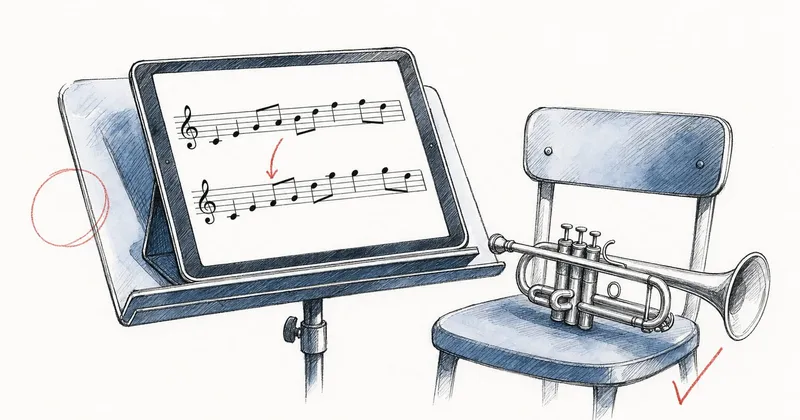
Guides
Why a PDF reader can't change the key, which apps can (from scan-and-transpose tools to chord chart apps), how transposing instruments work, and a worked example by hand.
Filter every sheet music app by the devices you use, how you want to pay and the features you can't do without.